
What is this?
While configuring a router, I ran into all sorts of internet connection methods,
so this article is my attempt to figure out what each one actually means.
The sections with a blue background are background knowledge, so feel free to skip them.
An explanation? (sort of)
Calling this an "explanation" might be a stretch — it's more of a quick summary.
I'm not fully confident it's accurate, so please check the references below too.
What is IPv4?
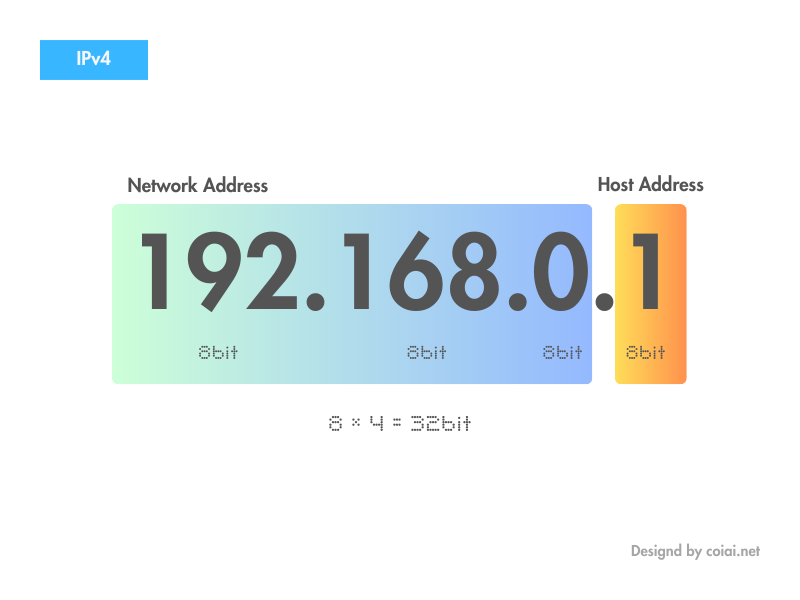
IPv4 (Internet Protocol version 4) is the primary protocol used to send and receive data over the internet. It identifies devices on a network using a 32-bit number called an IP address (e.g., 192.168.0.1).
Characteristics
- A 32-bit address space (about 4.2 billion addresses)
- Uses packet-based communication
- Can divide networks into subnets using a subnet mask
What is IPv6?
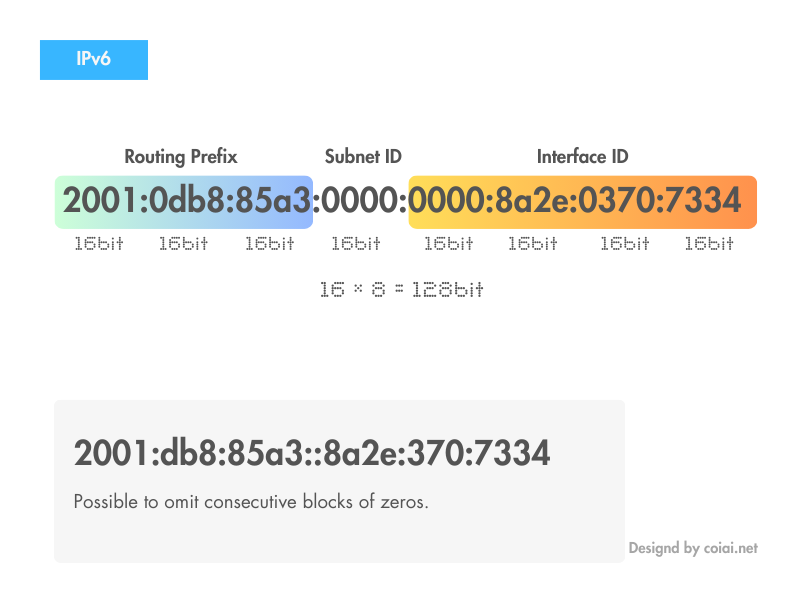
IPv6 (Internet Protocol version 6) was developed as the successor to IPv4 and provides far more IP addresses. It has a 128-bit address space, letting it uniquely identify vastly more devices than IPv4.
IPv4's problems
1. Address exhaustion
IPv4's 32-bit address space can only provide about 4.2 billion addresses.
As the internet has grown, these addresses have been running out fast .
Because of this, rather than assigning one IPv4 address per subscriber, providers sometimes share a single public IPv4 address across multiple households.
2. Security
By design, IPv4 doesn't have sufficient built-in security features. You can add security features like IPsec, but they aren't included by default.
To address these issues, technologies like DS-Lite and MAP-E, covered below, were developed.
DS-Lite (Dual-Stack Lite)
I'm subscribed to Rakuten Hikari, and its default settings recommend this option, so I was using DS-Lite.
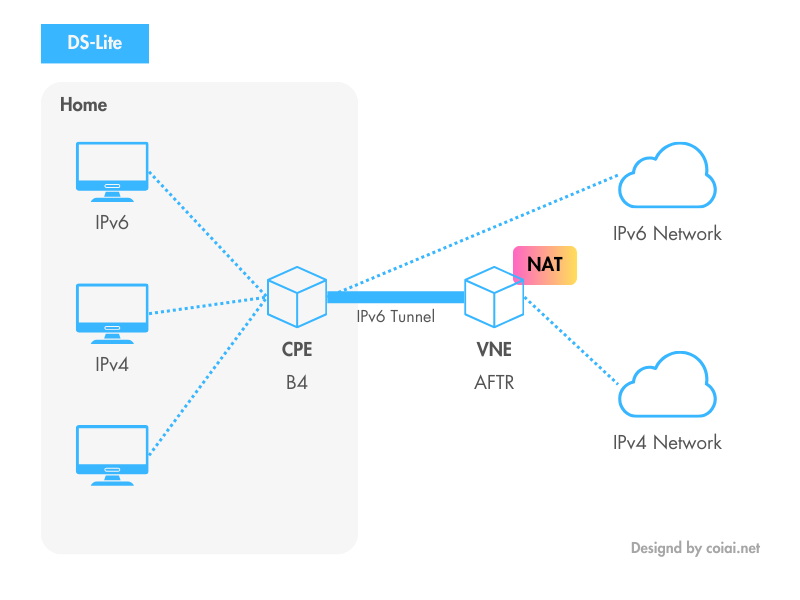
DS-Lite is a technology for dealing with IPv4 address exhaustion — it works by encapsulating IPv4 packets inside IPv6 packets to send them over the internet.
The IPv4 packets you send get wrapped in IPv6 packets and sent to your provider, and the provider unwraps them back into IPv4 packets to connect to the internet.
Key points
- Uses IPv4 and IPv6 at the same time
- Addresses the IPv4 address exhaustion problem
- Since NAT happens on the provider's side, opening ports is difficult
MAP-E (Mapping of Address and Port using Encapsulation)
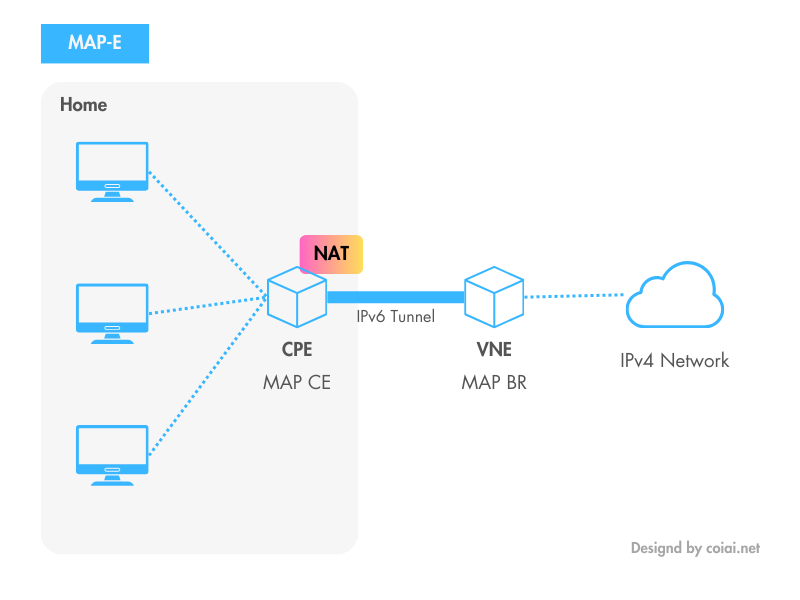
MAP-E is an IPv6 transition technology that lets multiple users share IPv4 addresses.
It encapsulates IPv4 packets inside IPv6 and carries IPv4 traffic over IPv6 infrastructure.
This lets an ISP have multiple users share a single IPv4 address .
Key points
- Since NAT happens on the router's side, opening ports is possible
PPPoE (Point-to-Point Protocol over Ethernet)
PPPoE is a protocol that establishes a PPP session over an Ethernet network and authenticates using a username and password.
It's mainly used for DSL connections and works well for sharing a single internet connection across multiple devices in a household.
Key points
- Has an authentication feature
L2TP (Layer 2 Tunneling Protocol)
L2TP is a protocol for establishing a VPN (Virtual Private Network).
It combines features of PPTP and L2F, encapsulating PPP packets inside IP packets to transmit them over the internet.
L2TP works across a variety of network types and provides strong encryption and authentication features .
Key points
- Used to build a VPN
- Provides strong encryption and authentication
- Can be used across a wide variety of networks
PPTP (Point-to-Point Tunneling Protocol)
PPTP is also a technology for building a VPN, but it doesn't offer the level of security that L2TP does.
It's used to let remote users securely connect to a private network.
Key points
- Used for building a simple VPN
- Relatively low security
- An older technology that's gradually being replaced
v6 plus
v6 plus is a technology that allows IPv6 and IPv4 to be used simultaneously, enabling IPv4 communication over an IPv6 network. This solves the IPv4 address exhaustion problem while still letting you access existing IPv4 services.
It seems to be a Japanese standard run by NTT and others — it struck me as a mechanism pretty similar to DS-Lite.
So, in the end?
I'm not sure this is entirely correct, but here's my overall take. If I got something wrong, I'm terribly sorry.
Before you even get to "IPv4 is slow" or whatever, the addresses are already exhausted,
so it's not one IPv4 address per router (more like one shared across dozens of households?), which means opening a port requires switching from v4 to v6.
But DS-Lite and MAP-E are hard to set up (at least, I couldn't do it on a consumer router like the TP-Link Archer AX10),
so you'd have to switch to PPPoE — except that adds authentication overhead, which is a lot to ask of the router you use for everyday internet.
In the end, I learned that because IPv6 is global and can connect directly to the network (presumably because there are so many addresses that every device can have its own),
you can keep the router on DS-Lite and expose your service to the internet just by configuring things on the PC side.
References
What is DS-Lite?
https://techlog.iij.ad.jp/archives/1254